
When Doing Right Stops Being a Strategy


A client sat across from me recently and said something that stopped me cold.
"What's the point of all these efforts, staying dignified, when she's not transparent with me? When she keeps showing me she's leaving? I'll hold myself upright for a few more months, but there will come a moment when I cut ties. She won't see me again. No question of staying friends."
I recognized that voice immediately.
It was the same voice that spoke in my head last October, during what should have been a celebration in France.
The Transaction We Don't See
We were hosting four friends for some holidays. One of our friends turned 50. Two couples. They arrived as guests and quickly formed something else—a hermetic unit that excluded us from our own holidays. We became facilitators. Logistics managers in our own home.
During a game, one of them mocked Nathalie with what I can only describe as deaf violence. The kind that leaves no visible marks but changes the air in the room.
Later, they planned a trip to Bordeaux. We weren't really included.
I decided to take the high road.
I sent a message. I spoke my truth with what I thought was dignity. I addressed the exclusion, the mockery, the hurt. I tried to "clean" the situation with honest communication, expecting that acting like an adult would invite them to do the same.
They replied vaguly about "misunderstandings."
When they returned from Bordeaux, one walked past me, muttered "Chaud" (hot), and went about his business. No apology. No engagement. Just that single word hanging in the air like smoke.
My dignity didn't compel them to respect me. It just highlighted that they literally could not see me.
I eventually cut ties. I didn't send Christmas wishes.
And in the quiet that followed, I realized something uncomfortable: my integrity had been transactional all along.
The Hidden Bargain
Both my client and I were operating from the same hidden expectation. We believed that if we acted with dignity, people would respect us. If we maintained our integrity, others would acknowledge it. If we did the right thing, it would matter.
We were using dignity as a bargaining chip.
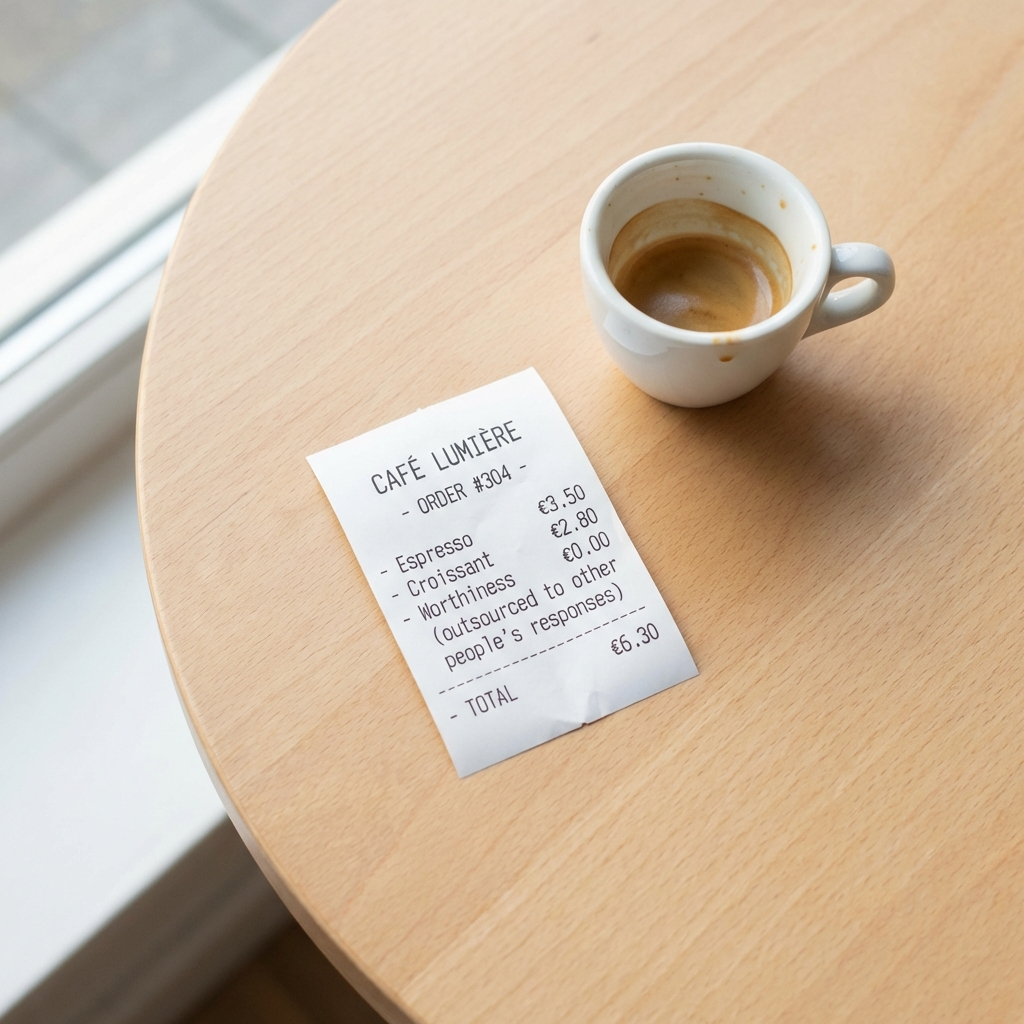
The pain that comes when this bargain fails isn't just about being unseen. It's about something deeper. We've been outsourcing our worthiness to other people's responses. We've granted others the power to tell us we're worthy—worthy of our efforts, worthy of being loved, worthy of appreciation.
My client believes he's a good man if she says so or shows it. I believed I was a good friend if they responded to me as one.
We just want to be seen for our efforts.
Until we realize the effort is enough.
The Weight We Carry
There's a gap between "I need them to tell me I'm worthy" and "the effort is enough." That gap is filled with fear. Fear of loss. Fear of being left alone.
But the gain is dignity held dear.
Here's the question I had to ask myself, and the one I now ask my client: when you're holding dignity dear in that gap, while the fear is still there, are you holding it for yourself? Or are you still partly holding it as evidence to show them later?
"See, I maintained my dignity even when you didn't see me."
Sometimes they both survive and show up alternatively: one is loud and hurts, the other is quiet and brings relief. The loud one? It’s an indicator that you're not yet free. You're still attached. You're still conditioning your behavior to what people think or do.
My client says he'll hold himself upright for a few more months before cutting ties. But if he's truly upright—truly vertical in the way I've come to understand it—he wouldn't condition his behavior to a result.
He's still carrying a weight while trying to stand straight.
What Vertical Actually Means
I use the word "vertical" deliberately. It's not just a metaphor.
Feeling vertical means letting go of a weight—the unconscious weight your body carries when you hold on to expectations and conditioning. It's a felt experience similar to physically jumping into the void.
When you let go of that weight in a breath, your body automatically straightens. You feel energy flow again within you.
The body knows the difference before the mind does.
When you're vertical for yourself, there's no sideways glance to see if they notice. There's no mental calculation about whether your dignity is working as a strategy. There's just the straightness itself.
But when you're vertical while still glancing sideways, you're performing verticality. You're acting with dignity while secretly acting for dignity.
The difference is subtle but everything.
The Relief That Costs Pain
Realizing that the effort should be enough brings relief. But that relief costs pain.
The pain is in severing the conditional attachment. It's mourning the version of yourself who believed being good would make you visible. It's grieving the fantasy that integrity is a strategy that works.
Someone once told me: "If you lose a friend, they were never a friend."
That sentence lands differently depending on where you are in the process. At first, it sounds harsh. Later, it sounds like freedom.
The pain lasts until you let go. And letting go isn't a decision you make once. It's a practice. A returning. A remembering.
Self-Remembering
True dignity isn't a strategy to change others. It's self-expression.
It's who you are when no one is keeping score. When no one is watching. When your efforts go unacknowledged and your integrity goes unrewarded.
The absence of recognition is actually the truest test of genuine integrity.
Because when recognition comes, it's easy to confuse the feeling of being seen with the feeling of being worthy. But worthiness doesn't come from being seen. It comes from seeing yourself.
This is what I mean by self-remembering. Acting from internal values rather than anticipated outcomes. Cultivating visibility internally instead of negotiating for it externally.
My client will know he's free when he stops conditioning his behavior to whether she changes her mind. When he can hold himself upright not for a few more months as a strategy, but because that's simply who he is.
I knew I was free when I stopped replaying that moment with that guest in my head, rehearsing what I should have said, imagining scenarios where they finally understood.
Freedom came when I stopped needing them to understand.
The Practice
This shift from doing to being doesn't happen all at once. You catch yourself mid-transaction. You notice the weight. You feel the sideways glance.
And then you breathe. You let go. You straighten.
You act with dignity not because it will make people respect you, but because it's an expression of who you are. Not a performance for an audience, but a practice for yourself.
The effort is enough.
Not because someone says so. Not because it yields results. Not because it changes their mind or makes them see you.
The effort is enough because you say so.
That's what it means to hold dignity dear. Not as a bargaining chip. Not as evidence. Not as strategy.
Just as yours.